Thermo Fisher Scientific
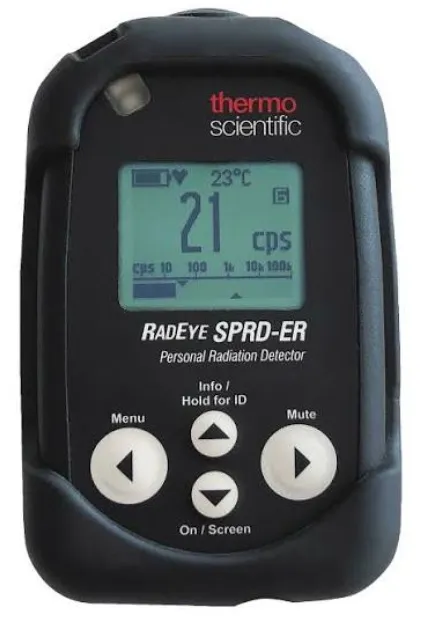
RadEye SPRD-ER Personal Radiation Detector
Extended dose rate range combined with search, find and radionuclide identification capability.
The SPRD-ER is intended for specialists and hazmat or CBRNe teams who need to identify the type of radiation while also being able to monitor high dose rates. After an alarm the instrument guides the user through the next steps, and results are shown automatically without the need to press buttons.
- Detects, identifies and categorises sources of radiation, e.g. as natural or medical
- High dose rate detector for dose rate monitoring up to 10 Sv/h
- NBR distinguishes artificial radiation from natural background and reduces false alarms by 80 % without increasing alarm thresholds, according to the manufacturer
- Sourceless gain stabilisation and licence-free lutetium test adapter for checks in the field
- Optional Bluetooth with iOS and Android app, RadResponder compliant
No prices online – you will receive a quotation with price and delivery time. Need accessories? Mention them in your request.
Authorised distributor in SwedenAll products from Thermo Fisher Scientific →
Technical data
| Radiation detected and analysed | Gamma and X-rays plus neutrons via prompt gamma |
|---|---|
| Detectors | CsI(Tl) low dose rate detector; patented scintillator high dose rate detector |
| Sensitivity (662 keV) | 200 cps per µSv/h (low dose rate); 25 cps per mSv/h (high dose rate) |
| Dose rate range | 10 nSv/h – 250 µSv/h (low dose rate); < 10 Sv/h (high dose rate) |
| Typical ID time | < 3 minutes at 1 µSv/h |
| Alarm notification | Display, LED, sounder, vibe |
| Battery | 2 × AAA alkaline (> 170 h) or rechargeable NiMH (> 100 h) |
| Ruggedness | IP 65; drop tested 1.5 m on concrete (with rubber sleeve) |
| Operating temperature | −20 °C to 50 °C |
| Dimensions | 4.1 × 2.6 × 1.6 inches (with rubber protective sleeve) |
| Weight | 179 g including batteries and rubber sleeve |
| Standards compliance | ANSI N42.48, ANSI N42.33, IEC 60846-1 |
Source: Thermo Fisher Scientific, RadEye PRD and SPRD brochure (2024). Full specifications are available in the documents.