Thermo Fisher Scientific
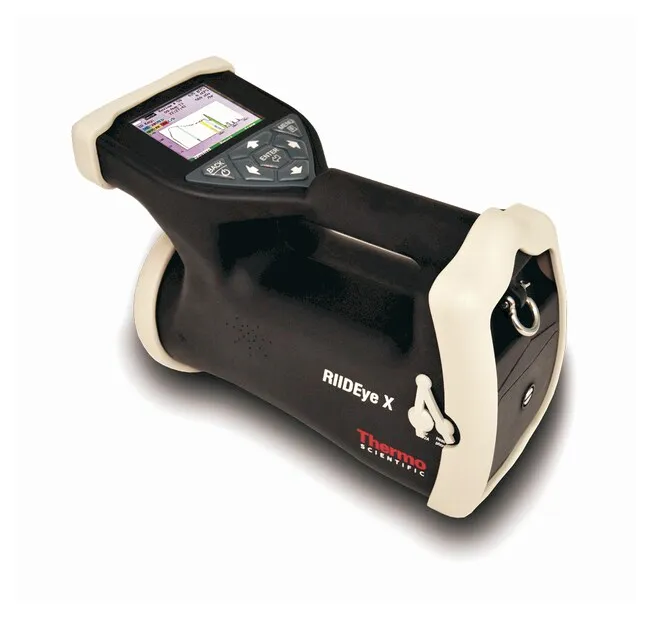
RIIDEye Handheld Radiation Isotope Identifier
Handheld radiation isotope identifier (RIID) for fast real time identification of gamma sources in the field, with NaI or high-resolution LaBr detector and a neutron channel option.
Available in three versions: RIIDEye-G with a 2″ × 2″ NaI(Tl) detector, RIIDEye-GN with a neutron detection channel, and RIIDEye-G-HiRes with a high-resolution LaBr detector. The end caps are colour coded for immediate recognition of the detector type, and the well spaced 7-key pad can be used with protective gloves.
- Patented QCC algorithm provides real time gamma source identification
- Colour coded peaks in the spectrum show at a glance whether material is benign or a threat
- Continuous gain stabilisation with natural potassium – no integral Cs-137 source
- Detector detaches with a single clip for two-hand operation with the extended cable
- Spectra stored on a removable memory card, easy reach-back in ANSI N42.42 format
No prices online – you will receive a quotation with price and delivery time. Need accessories? Mention them in your request.
Authorised distributor in SwedenAll products from Thermo Fisher Scientific →
Technical data
| Detector | Standard 2″ × 2″ NaI scintillator; 1.5″ × 1.5″ LaBr and 3″ × 3″ and larger NaI are available |
|---|---|
| Energy range | 20 keV to 3 MeV |
| Functions | Isotope identification, spectral analysis, dose rate meter, source locator |
| Neutron detector | Optional non He-3 dual scintillator with embedded lithium (NaI detectors only) |
| Library | Standard ANSI, medical, industrial, SNM or user defined |
| Alarms | Audio and visual on screen |
| Display | 320 × 240 high brightness 32000-colour 3.5 inch LCD |
| I/O | Ethernet and removable memory card |
| Battery life | 8 hours nominal with standard battery pack (commercial AA batteries) |
| Temperature | −20 °C to 50 °C |
| Dimensions (with 2″ × 2″ NaI) | 32 × 25 × 15 cm |
| Weight | 1.4 kg with 2″ × 2″ NaI detector |
Source: Thermo Fisher Scientific, RIIDEye product specifications (2012). Full specifications are available in the documents.